
Catamaran vs Monohull: A Comprehensive Comparison for Informed Yacht Selection
Selecting between a catamaran and a monohull is a strategic decision that directly impacts operational costs, onboard comfort, sailing performance, and long-term ownership value.
At Kyriakoulis Yachts, we regularly advise clients evaluating the catamaran vs monohull question for cruising, charter investment, and private ownership. This guide provides a structured comparison to support informed decision-making.
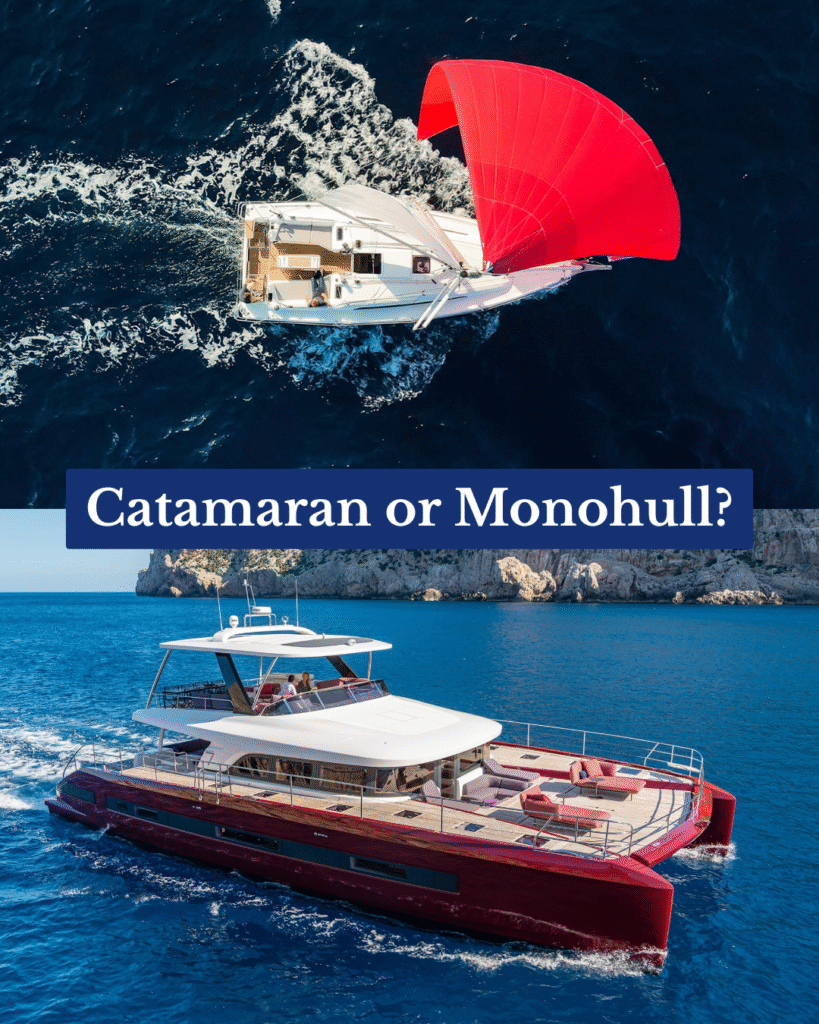
Structural Overview: Understanding the Core Difference
A monohull features a single hull design and heels under sail, which enhances hydrodynamic efficiency and upwind performance.
A catamaran consists of two parallel hulls connected by a bridgedeck, offering enhanced stability, increased beam, and expanded living space.
This fundamental design distinction influences stability, comfort, cost structure, and performance characteristics.
1. Stability and Onboard Comfort
Catamaran
- Minimal heeling under sail
- Wide beam for increased deck and interior volume
- Greater cabin separation and privacy
- Enhanced comfort for guests and families
Catamarans are widely regarded as optimal for leisure cruising and charter operations due to their flat sailing profile and spacious layout.
Monohull
- Predictable motion in offshore conditions
- Proven bluewater sailing characteristics
- Traditional sailing dynamics preferred by experienced sailors
While monohulls heel under sail, many offshore sailors consider this motion more natural and performance-oriented.
Operational Advantage:
- Leisure & charter comfort: Catamaran
- Offshore passage-making: Monohull
2. Performance and Sailing Efficiency
Performance requirements vary significantly depending on sailing objectives.
Catamaran Performance Profile
- Strong performance in light to moderate winds
- Higher average cruising speeds
- Reduced drag due to slender hull design
Monohull Performance Profile
- Superior upwind capability
- Efficient in heavy weather conditions
- Greater responsiveness under sail
For Mediterranean and Caribbean cruising environments, catamarans often deliver faster passage times. For extended offshore passages in varied conditions, monohulls remain highly respected.
3. Acquisition and Operating Costs
Cost remains a primary consideration in the monohull vs catamaran comparison.
Initial Investment
- Catamarans typically command a 20–40% higher purchase price
- Strong resale demand in the charter market
Berthing and Marina Fees
- Catamarans incur higher docking costs due to beam width
- Monohulls benefit from easier marina availability
Maintenance Considerations
- Catamarans commonly operate dual engines
- Increased hull surface area may elevate maintenance costs
From a capital efficiency standpoint, monohulls often present a lower barrier to entry. However, catamarans can deliver stronger charter revenue potential depending on market positioning.
4. Space Utilization and Liveaboard Capability
Space optimization is one of the defining advantages of multihull vessels.
Catamaran
- Expansive cockpit and saloon areas
- Elevated galley layouts in many models
- Private hull-separated cabins
- Ideal for charter fleets and extended liveaboard programs
Monohull
- Efficient interior layouts
- Narrower beam limits overall volume
- More compact private spaces
For clients prioritizing onboard comfort, entertaining, or charter operations, catamarans offer measurable advantages in usable space.
5. Safety Considerations
Both vessel types meet modern offshore safety standards when properly equipped and maintained.
Monohull Safety Profile
- Self-righting capability
- Established offshore heritage
Catamaran Safety Profile
- High inherent buoyancy
- Exceptional initial stability
- Extremely low sinking risk
The appropriate choice depends on cruising plans, crew experience, and operating environment.
Strategic Recommendation Framework
When advising clients, we typically assess:
- Intended cruising region
- Charter vs private ownership model
- Budget allocation
- Crew experience level
- Long-term resale objectives
A Catamaran May Be Preferable If:
- Comfort and stability are primary priorities
- The vessel will be used for charter operations
- Entertaining and family cruising are key objectives
- Warm-climate coastal cruising is planned
A Monohull May Be Preferable If:
- Offshore passage-making is anticipated
- Budget efficiency is essential
- Traditional sailing performance is desired
- Marina flexibility is required


Conclusion: Aligning Vessel Type with Strategic Objectives
The catamaran vs monohull decision should not be framed as a matter of superiority, but rather alignment.
Each platform offers distinct operational advantages. The optimal selection depends on how the vessel will be deployed, the experience level of the crew, and long-term financial considerations.
At Kyriakoulis Yachts, we provide tailored consultations to help clients evaluate vessel type, ownership model, and cruising strategy to ensure the right investment decision.